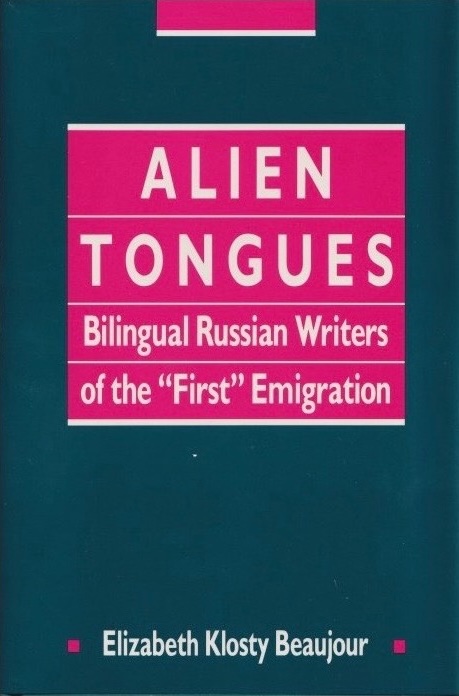
The achievements of bilingual writers, Elizabeth Klosty Beaujour asserts, have rarely been considered whole. Integrating the recent findings of neurolinguistics with the insights of literary criticism, Beaujour says that writers who have created significant bodies of work in more than one language are in many respects different from monolingual writers and must be seen in their linguistic complexity to be properly understood. Beajour first offers a concise introduction to the neurolinguistics of literary bilingualism and shows how bilingual writers themselves characterize their linguistic and psychological distinctiveness. In Beajour’s view, the Russians of the “first” post-1917 emigration make up a relatively homogeneous group, part of a sudden displacement of a large segment of a cultured community. Focusing on Vladimir Nabokov, Elsa Triolet, Vasily Yanovsky, and Zinaida Shakhovskoy, Beaujour finds common patterns in the works and artistic development of major bilingual writers of the “first” emigration who successfully made the transition to writing in a language other than the one in which they had first defined themselves as artists. She next contrasts these authors with exiled compatriots such as Marina Tsvetaeva and Boris Poplavsky who had the potential to become bilingual authors but who chose to continue to write in Russian, following the precept of Osip Mandelstam in refusing to “tempt alien tongues.” Beaujour then compares the trajectories of the Russian bilinguals with that of their Irish contemporary Samuel Beckett, perhaps the most determinedly and uncompromisingly bilingual of any modern writer.
“In this fascinating study, which takes the field of neurolinguistics as its point of departure, the author acutely analyzes the significance of bilingualism for certain major twentieth century writers. One feels at all times the guidance of a witty, informed, and intelligent critic. A major contribution.” - Richard Sheldon, Dean of the Humanities, Dartmouth College
The achievements of bilingual writers, Elizabeth Klosty Beaujour asserts, have rarely been considered whole. Integrating the recent findings of neurolinguistics with the insights of literary criticism, Beaujour says that writers who have created significant bodies of work in more than one language are in many respects different from monolingual writers and must be seen in their linguistic complexity to be properly understood. Beajour first offers a concise introduction to the neurolinguistics of literary bilingualism and shows how bilingual writers themselves characterize their linguistic and psychological distinctiveness. In Beajour’s view, the Russians of the “first” post-1917 emigration make up a relatively homogeneous group, part of a sudden displacement of a large segment of a cultured community. Focusing on Vladimir Nabokov, Elsa Triolet, Vasily Yanovsky, and Zinaida Shakhovskoy, Beaujour finds common patterns in the works and artistic development of major bilingual writers of the “first” emigration who successfully made the transition to writing in a language other than the one in which they had first defined themselves as artists. She next contrasts these authors with exiled compatriots such as Marina Tsvetaeva and Boris Poplavsky who had the potential to become bilingual authors but who chose to continue to write in Russian, following the precept of Osip Mandelstam in refusing to “tempt alien tongues.” Beaujour then compares the trajectories of the Russian bilinguals with that of their Irish contemporary Samuel Beckett, perhaps the most determinedly and uncompromisingly bilingual of any modern writer.
“In this fascinating study, which takes the field of neurolinguistics as its point of departure, the author acutely analyzes the significance of bilingualism for certain major twentieth century writers. One feels at all times the guidance of a witty, informed, and intelligent critic. A major contribution.” - Richard Sheldon, Dean of the Humanities, Dartmouth College